I woke up early to the sounds of a cat crying insistently and of a German tourist telling the hostel worker her plans. Leaving my window open had been a mistake.
I gave up sleeping eventually, and showered and packed. The woman who worked there was no longer in the courtyard when I came out. No one had asked me for money the night before or even my passport, but no matter--Mama's Naxi Guesthouse was actually three guesthouses, and breakfast was served at a different one. I had a banana pancake there, actually a large piece of flat fried bread covered in sliced bananas, and paid for both the pancake and the room.
I was supposed to meet Cun Xuerong, the ecolodge manager, at 10:00 at a water wheel on the other side of the Old Town. My experience the night before had taught me that the Old Town is very difficult to navigate for the uninitiated, but miraculously, I arrived at 10:00 exactly. Mr. Cun, a handsome 30-something man with an urban air, found me quickly. He doesn't speak English, it turned out. I expressed surprise, since the emails from Wenhai had been signed with his name, but he said someone else had written them. The woman I'd talked to on the phone, surely.
We managed to communicate surprisingly well in Chinese, though. Perhaps Mr. Cun is used to talking to foreigners with a weak grasp of the language. Was I American? Yes. Was I working in China? I'd learned the word for "work" but forgotten it. I looked it up, then told him I didn't have a job in China, but was a tourist. Where had I studied Chinese, then? In college. Mr. Cun seemed pleasantly surprised to hear that colleges in America offer Chinese. He asked whether the instructors were Chinese or American. I said they were Chinese. It was by far the most successful conversation I'd had in Mandarin since arriving in the country.
Mr. Cun drove me in his Jeep to the foot of a mountain, where we waited for the guide and horse(s) to arrive. When I'd asked for the horse option I'd optimistically expected a guide on a horse, a horse for me, and perhaps a third animal for luggage, but now I worriedly watched a middle-aged man lead one small, dark, slightly mud-speckled horse out of the woods. Mr. Cun introduced me to Mr. He and told me to put my backpack on and mount the horse, which I did with some difficulty. The saddle was what I assumed to be the Naxi traditional style, unpadded with a hard loop of a handle in front.
I didn't particularly like being the tourist led along on a horse, but on our way up the mountain we saw Han tourists doing it too, and one middle-aged waiguoren couple. The path was steep, and the horse had to stop periodically to catch its breath. It wasn't long before my knees were stiff, my backside was sore, and I wished I were walking.
Mr. He is perhaps about 40, and small. He wore a battered sport coat, corduroys, and shoes resembling soccer cleats, plus a backpack with the vegetables Mr. Cun had bought for my meals. He didn't talk much.
We passed a dam, then a small reservoir. We crested the pass and soon afterward Mr. He suggested that I walk for the next stretch, which was particularly steep. I did so gladly, although my knees were so stiff I could barely walk at first. My dismount was no more graceful than my mount--I wasn't feeling like much of a martial artist.
Further down he had me get back on the horse, which moved away as I did. I joked that he didn't like me, but it wasn't really a joke.
As we neared the village we began to pass Naxi who weren't leading tourists on horses. Mr. He talked to all of them in a staccato language. We arrived at around 1:00, and Mrs. He cooked me lunch. It was simple and excellent: one plate of tomatoes and scrambled eggs, another of mushrooms and garlic, plus, of course, rice from a giant cooker.
But it soon began to seem to me that there was something off about the ecolodge. Mr. Cun had told me, when I asked him, that there were no other guests at the moment, and I hadn't expected luxury accommodations. but I had expected some sort of orientation. The Hes spoke no English, and the English-speaking woman I'd spoken to on the phone was nowhere in evidence. I'd have settled for a printout suggesting things to do, or even a patient explanation in Chinese and sign language, but it seemed that once I'd been shown my room and fed, I was on my own. Also, there was a distinct atmosphere of neglect: Huge cobwebs in the bathroom and hallways, plastic bottles piled under the stairs, and a receipt left in my room from the Grand Lijiang Hotel dating from early September.
Yet there was ample evidence that much care had gone into this place at one time. In the common room, where I ate, a sign announces that the lodge had been launched with funds from the Nature Conservancy and the Japanese government. The Nature Conservancy wanted to foster sustainable tourism in China to benefit the environment, and the Japanese wanted to show their friendship and help the people of Wenhai. Big framed posters, now dirty and faded, declaim in Chinese and flawless English on the philosophy of ecotourism, life in Wenhai, and regional flora and fauna. There are clipped articles on the lodge from the travel sections of the Daily Telegraph, the Far Eastern Economic Review, and the New York Times. These last two were both written in 2004 by the same freelancer, Craig Simmons. The articles sunnily describe the beauty of the setting, the difficulty of reaching the lodge, and its ecological amenities, which include solar panels, a biogas system, and a greenhouse. I wondered whether any of these were still working.
It was only 2:00, so I decided to do a little exploring. On my way out Mrs. He asked where I was going, and I answered truthfully that I didn't know. Perhaps I should have tried to provide more information.
I ambled around Wenhai Lake, which I'd learned is a seasonal lake, although I'm not quite clear on when it disappears. The only wildlife I spotted was a toad, but there were more free-roaming domestic animals than I'd ever seen before in one place: pigs, chickens, dogs, horses, cattle. I even saw some yaks, the first I'd ever seen outside of a zoo. The lake, the tiny streams that feed it, and the mountains--especially Jade Dragon Snow Mountain--made for some beautiful views. Time seem to melt away: Every time I looked at my watch, another hour had elapsed.
I got back to the ecolodge as it was growing dark, and Mrs. He served me three dishes this time, plus the ubiquitous tea (with a huge thermos for refills). As I was eating Mrs. He came in and handed me a cell phone. It was the English-speaking woman I'd talked to the day before. I don't know what she sounds like in Chinese or Naxi, but in English she comes across as strident.
"Hello? How are you?" with preliminaries out of the way, she asked me what I planned to do the next day. I said I didn't know. She told me I could walk around the lake and village by myself, but to go further afield I would need a guide. I didn't argue about that. She said that my options for the next day included climbing a mountain or walking to some Yi villages. Weighing this, I asked how far away the villages were. "Two are close, but two are farther away. But if you get tired you can just tell the guide, he'll take you home." I asked how difficult the climb up the mountain was. "If you get tired, I think you can tell Xiao He "hui jia," or you can speak to him in English, because he has guided many foreigners and I think maybe he understand you." This response seemed unecessarily patronizing--of course I could tell Mr. He "hui jia"--but if could communicate so well with the Hes, why was she calling me? I said I'd like to visit the Yi villages, and handed the phone back to Mrs. He.
The temperature dropped quickly after sundown, and the lodge was unheated, so I headed upstairs soon after dinner, taking the massive thermos with me. Next to my room was a door to the roof, and I went out. Here were the famous solar panels, or two of them anyway. One had a towel drying on it. On the wall were what appeared to be the panels' control or monitoring devices, but their digital displays were dark. Just to the side of the roof was a greenhouse I'd read about on an informative poster in the bathroom. In addition to nurturing vegetables, it was supposed to keep the biogas digester warm in winter so that it would keep working. But its clear plastic roof was almost entirely torn away, and the floor had been reclaimed by weeds.
I was sitting in bed reading about the Naxi in Lonely Planet when Mrs. He knocked at the door. I found her very difficult to understand. She asked whether I had a question or problem. I said no. She said something about the phone call. I tried to say yes, the woman on the phone and I talked about my going to the Yi villages tomorrow. She asked me something that I didn't understand. She said never mind, go back to sleep. Confused, I went back to bed.
Showing posts with label cat. Show all posts
Sunday, February 22, 2009
Thursday, January 01, 2009
Forbidden fruit
I woke up late and went down to take a shower in the cobwebbed bathroom that Simmons described as "shared but clean" (it was neither shared nor particularly clean at the moment). There was no hot water, where depressed me. Not because I couldn't shower, which didn't seem too important in a place this remote, but because the water was supposed to be heated by the solar panels. I stood shivering in the concrete bathroom, with its bilingual posters on sustainability, and decided there was no way I could stay there for the three nights I'd reserved.
At breakfast I asked Mr. He for the cell phone, and told the English-speaking woman I'd like to leave the next day. She didn't ask why or seem disappointed, just asked how I'd like to get down the mountain. I said I'd like to walk but have the horse carry my bag. She said sure, and would I like to go the same way or take a different route down the mountain? I chose the latter.
Mr. He and I set off after breakfast (dumplings and shredded potatoes). I'd thought there were no shops at all in Wenhai, but on the way out of the village Mr. He bought something at a window in a cinder block building. Certainly people find a way to buy things there, judging by the snack wrappers and beverage containers that litter the paths. Probably there isn't much of a trash-disposal system there.
We passed through one tiny Yi village where no one was about. Before we even saw the second village I heard gun reports periodically, which echoed from the other side of the valley like soft thunder. Closer in I thought I heard firecrackers, too. But it was the middle of the day.
As we got closer still I saw a large group of people gathered on a path above the village. The shots were being fired into the air from a field next to them. There was cheering and laughter. Further up the hillside a yak was tied to a tree.
I asked Mr. He what was going on, and he said it was a "si le." This wasn't in my dictionary, but I assumed it meant a wedding. He pointed to the yak and drew the blade of his hand across his neck to indicate it would be killed.
In the village proper a trio of children stared at me, and I stared at two old women in bright colors and hats that had a large black-draped flat rectangle. The hats reminded me a little of the Flying Nun, or maybe of large graduation caps. I could see that the women at the wedding were dressed the same way.
Mr. He and I took a break on a pile of timber off the village's main drag, where we watched the festivities from a distance. In addition to the shots and firecrackers and laughter, there was a strange howl-like singing going on. Eventually the wedding party paraded down the main road through the village, some bearing a white sheet on poles that they' also been holding up on the hillside. When I looked up at the yak again, some men were gathered around it; it appeared to be dead already. I realized I knew how to ask Mr. He whether the villagers dressed like that every day. He said they did.
We moved on, and Mr. He asked whether I wanted to go to another village. I said sure--it was only mid-day, and I'd no desire to go back to the weedy ecolodge. We descended steep goat paths to the valley floor, and started up the other side.
When we stopped for a breather I noticed a plant with a fruit hanging down. It was wedge-shaped, almost as big as my hand, covered in pomegranate-like seeds. Mr. He saw me noticing the plant and indicated it was edible. I was there to try new things, right? I stepped off the path, plucked the fruit, and took a bite of the red seeds. They came off like kernels from a corn cob, except more easily. The taste was sweet, but... very tangy...
Suddenly Mr. He was beside me. "Bu chi" he said ("don't eat"). I spit out the seeds. Mr. He made digging motions to indicate it's actually the root that edible, but it was too late. The inside of my mouth felt stung by a thousand sharp pins. I spit and spit, but moving my mouth just made it hurt more. My eyes and nose watered. I didn't know how long this pain would last, or whether it would get worse. What if my throat swelled shut? But I felt strangely calm, and continued following Mr. He uphill. I discovered that keeping my mouth perfectly still made the pain more bearable, so I did.
A short way up Mr. He sat down for a break. He watched me intently but didn't say anything, and I appreciated his wordless concern. I leaned against a rock nearby. Finally he asked whether I was hungry, and I said no. Eating was the very last thing I wanted to do, but I didn't know how to say that. In fact my lips and tongue felt swollen, which did nothing to improve my Chinese-speaking ability. He gave me a piece of candy. I tried to refuse, but he insisted, and I thought maybe the sweetness would help, so I popped it into my mouth. Ow. Eating the candy required moving my mouth, which was nearly unbearable. When we were within sight of the next village he handed me another piece. I refused harder this time, trying with my burning mouth and bad Chinese to explain that eating hurt, but he insisted harder. I slipped the candy into my pocket when he turned his back to make a phone call. Half of the last piece of candy was still stuck to my molars.
Mr. He talked to someone in Naxi. I thought he was probably trying to figure out what to do with me. We continued into the village, where Mr. He talked to a 50-ish man with glasses who was sitting in his yard. I could tell he was explaining what I'd done. The man went into a building I took to be a kind of workshop--no furniture, with a fire pit in the middle--and came out with a plastic container of what looked like sugar. The three of us walked to another house, where Mr. He told my story to another 50-ish man. We all went inside.
There were no windows, and no doors, just an entrance that was the main source of light at the moment. The secondary source was a fire in a pit in the middle of the room. There were two other rooms, one on each side of the main room. One doorway had a bare bulb handing over it, which wasn't on.
The second Yi man's wife motioned for me to sit on the one piece of furniture in the room, a wooden bed with no mattress. Mr. He and I sat there while the other adults sat on sacks around the fire pit. A boy and a girl, each about 6 or 8 years old, played happily inside and outside the house, dancing, giving each other piggy back rides, somersaulting. A black cat and three identical black kittens went about their cat business, and a couple of lean medium-small dogs wandered in and out. At one point a chicken paid a visit.
The woman communicated through wordless yells and hand signals, and her husband mimed things when talking to her, which confused me. It took awhile for me to realize she was deaf. I wondered whether anyone in a village like this could teach a deaf person to read--probably she is completely without language. We had something in common, although I couldn't even understand the sign language much of the time. While the men talked she watched me, a hand over her mouth. I wondered what she saw.
Potatoes were placed around the edges of the pit to bake. Mr. He took three flat rounds of bread out of his backpack and put them by the fire to warm. He used hot water from the kettle over the pit to make sugar water for me and tea for himself. The sugar water was tolerable, even a little soothing. I drank it slowly and tried to make friends with one of the kittens, which was having none of it. Eventually Mr. He peeled a potato and handed it to me. I tried to say no, but that wasn't working out well for me. I nibbled at it.
The woman put a sort of large wok with no handles over the fire pit and poured batter into it to make thick, flat, pancake-like bread. The host pulled pieces of honeycomb out of a plastic container, and when the first piece of bread was done, Mr. He folded half of it around a few pieces of honeycomb and handed it to me. I still had the potato, and warm honey immediately started dripping from the bread. I asked for a plate, and Mr. He brought me a bowl and chopsticks. By now we were sitting around the fire with everyone else. I felt awfully precious eating out of a bowl while everyone else ate with their hands, but what else could I do with all the food that was foisted on me? As I was using chopsticks to pick at the pancake, Mr. He handed me half a round of the bread he'd brought along. I balanced it on the bowl.
Periodically the men interrupted their chatter to try to talk to me in Mandarin. They spoke loudly and slowly, which helped only a little. Was I staying in Wenhai for two days? Yes, but in China for three weeks. The man in glasses observed that three weeks is twenty-one days. He was the easiest for me to understand. The host asked what time it was in America, and we chatted with sign language about how America was on the other side of the world. They asked me a few times how my mouth was, and I said better, but still not good. Glasses-man told me I wouldn't want to eat for three days, that I'd eat anyway, and that I wouldn't die--tremendously useful information.
The Yi men asked me about my family: Did I have brothers and sisters? Were my parents still alive? Did I have a boyfriend?
The next question: Was I 30? I said no, 28. Later I heard this come up again while they were talking with each other--28. Numbers were the only Chinese words I could recognize in their language.
The woman signaled at me at times, but I couldn't understand her much better. I think she told me that I'm very tall.
The men talked and drank clear liquid for hours. I looked around. Flattened cardboard boxes had been nailed to the back wall. Like everything else in the house, they were yellow-black from smoke. There was an old TV in the corner, which surprised me, but the real shock was the DVD player I noticed later.
At the end of our stay our host pulled a bottle of pink liquid from a corner by the bed and gave it to me. I asked whether it was alcohol; he said yes. I hesitated--I didn't want to use up any more of their best provisions, and I didn't have a glass, unless I emptied out my tea glass. The deaf woman mimed unscrewing the cap. Finally Mr. He took the bottle from me, poured a capful, and handed it to me. That was lucky, since otherwise I would have taken far to much. The taste was tart, raspberry-like, but not unpleasant. Mr. He took a capful after me, but he didn't like it. He handed out a last round a cigarettes, and we were off into the bright sunshine. I took a picture of our hosts in front of their house, and the man asked me to send him a copy. I said I would.
I didn't try to eat anything on the way back to Wenhai. I asked Mr. He whether the Yi language is the same as Naxi, and he said no, he understood only a little bit of Yi. Nevertheless he greeted everyone we met. Women's clothing in our hosts' village was different from what I'd seen at the wedding village; here, women wore long skirts with broad horizontal stripes of color, and pink scarves tied gypsy-style around their heads.
Back in Wenhai, we saw Mrs. He harvesting potatoes. She loaded them up and walked slowly down the road, bent at almost 90 degrees. There was a large bag of potatoes balanced on the basket on her back, which was also full of potatoes. Mr. He carried the hoe. According to Lonely Planet, Naxi culture was considered semi-matriarchal not long ago. I wondered what men did here.
Another meal by myself in the common room. I ate slowly and carefully, but I ate. It got cold quickly, and Mr. He brought in a bowl of smoldering embers to help. I went to bed early, taking a thermos of hot water and drinking glass after glass of increasingly weak tea.
At breakfast I asked Mr. He for the cell phone, and told the English-speaking woman I'd like to leave the next day. She didn't ask why or seem disappointed, just asked how I'd like to get down the mountain. I said I'd like to walk but have the horse carry my bag. She said sure, and would I like to go the same way or take a different route down the mountain? I chose the latter.
Mr. He and I set off after breakfast (dumplings and shredded potatoes). I'd thought there were no shops at all in Wenhai, but on the way out of the village Mr. He bought something at a window in a cinder block building. Certainly people find a way to buy things there, judging by the snack wrappers and beverage containers that litter the paths. Probably there isn't much of a trash-disposal system there.
We passed through one tiny Yi village where no one was about. Before we even saw the second village I heard gun reports periodically, which echoed from the other side of the valley like soft thunder. Closer in I thought I heard firecrackers, too. But it was the middle of the day.
As we got closer still I saw a large group of people gathered on a path above the village. The shots were being fired into the air from a field next to them. There was cheering and laughter. Further up the hillside a yak was tied to a tree.
I asked Mr. He what was going on, and he said it was a "si le." This wasn't in my dictionary, but I assumed it meant a wedding. He pointed to the yak and drew the blade of his hand across his neck to indicate it would be killed.
In the village proper a trio of children stared at me, and I stared at two old women in bright colors and hats that had a large black-draped flat rectangle. The hats reminded me a little of the Flying Nun, or maybe of large graduation caps. I could see that the women at the wedding were dressed the same way.
Mr. He and I took a break on a pile of timber off the village's main drag, where we watched the festivities from a distance. In addition to the shots and firecrackers and laughter, there was a strange howl-like singing going on. Eventually the wedding party paraded down the main road through the village, some bearing a white sheet on poles that they' also been holding up on the hillside. When I looked up at the yak again, some men were gathered around it; it appeared to be dead already. I realized I knew how to ask Mr. He whether the villagers dressed like that every day. He said they did.
We moved on, and Mr. He asked whether I wanted to go to another village. I said sure--it was only mid-day, and I'd no desire to go back to the weedy ecolodge. We descended steep goat paths to the valley floor, and started up the other side.
When we stopped for a breather I noticed a plant with a fruit hanging down. It was wedge-shaped, almost as big as my hand, covered in pomegranate-like seeds. Mr. He saw me noticing the plant and indicated it was edible. I was there to try new things, right? I stepped off the path, plucked the fruit, and took a bite of the red seeds. They came off like kernels from a corn cob, except more easily. The taste was sweet, but... very tangy...
Suddenly Mr. He was beside me. "Bu chi" he said ("don't eat"). I spit out the seeds. Mr. He made digging motions to indicate it's actually the root that edible, but it was too late. The inside of my mouth felt stung by a thousand sharp pins. I spit and spit, but moving my mouth just made it hurt more. My eyes and nose watered. I didn't know how long this pain would last, or whether it would get worse. What if my throat swelled shut? But I felt strangely calm, and continued following Mr. He uphill. I discovered that keeping my mouth perfectly still made the pain more bearable, so I did.
A short way up Mr. He sat down for a break. He watched me intently but didn't say anything, and I appreciated his wordless concern. I leaned against a rock nearby. Finally he asked whether I was hungry, and I said no. Eating was the very last thing I wanted to do, but I didn't know how to say that. In fact my lips and tongue felt swollen, which did nothing to improve my Chinese-speaking ability. He gave me a piece of candy. I tried to refuse, but he insisted, and I thought maybe the sweetness would help, so I popped it into my mouth. Ow. Eating the candy required moving my mouth, which was nearly unbearable. When we were within sight of the next village he handed me another piece. I refused harder this time, trying with my burning mouth and bad Chinese to explain that eating hurt, but he insisted harder. I slipped the candy into my pocket when he turned his back to make a phone call. Half of the last piece of candy was still stuck to my molars.
Mr. He talked to someone in Naxi. I thought he was probably trying to figure out what to do with me. We continued into the village, where Mr. He talked to a 50-ish man with glasses who was sitting in his yard. I could tell he was explaining what I'd done. The man went into a building I took to be a kind of workshop--no furniture, with a fire pit in the middle--and came out with a plastic container of what looked like sugar. The three of us walked to another house, where Mr. He told my story to another 50-ish man. We all went inside.
There were no windows, and no doors, just an entrance that was the main source of light at the moment. The secondary source was a fire in a pit in the middle of the room. There were two other rooms, one on each side of the main room. One doorway had a bare bulb handing over it, which wasn't on.
The second Yi man's wife motioned for me to sit on the one piece of furniture in the room, a wooden bed with no mattress. Mr. He and I sat there while the other adults sat on sacks around the fire pit. A boy and a girl, each about 6 or 8 years old, played happily inside and outside the house, dancing, giving each other piggy back rides, somersaulting. A black cat and three identical black kittens went about their cat business, and a couple of lean medium-small dogs wandered in and out. At one point a chicken paid a visit.
The woman communicated through wordless yells and hand signals, and her husband mimed things when talking to her, which confused me. It took awhile for me to realize she was deaf. I wondered whether anyone in a village like this could teach a deaf person to read--probably she is completely without language. We had something in common, although I couldn't even understand the sign language much of the time. While the men talked she watched me, a hand over her mouth. I wondered what she saw.
Potatoes were placed around the edges of the pit to bake. Mr. He took three flat rounds of bread out of his backpack and put them by the fire to warm. He used hot water from the kettle over the pit to make sugar water for me and tea for himself. The sugar water was tolerable, even a little soothing. I drank it slowly and tried to make friends with one of the kittens, which was having none of it. Eventually Mr. He peeled a potato and handed it to me. I tried to say no, but that wasn't working out well for me. I nibbled at it.
The woman put a sort of large wok with no handles over the fire pit and poured batter into it to make thick, flat, pancake-like bread. The host pulled pieces of honeycomb out of a plastic container, and when the first piece of bread was done, Mr. He folded half of it around a few pieces of honeycomb and handed it to me. I still had the potato, and warm honey immediately started dripping from the bread. I asked for a plate, and Mr. He brought me a bowl and chopsticks. By now we were sitting around the fire with everyone else. I felt awfully precious eating out of a bowl while everyone else ate with their hands, but what else could I do with all the food that was foisted on me? As I was using chopsticks to pick at the pancake, Mr. He handed me half a round of the bread he'd brought along. I balanced it on the bowl.
Periodically the men interrupted their chatter to try to talk to me in Mandarin. They spoke loudly and slowly, which helped only a little. Was I staying in Wenhai for two days? Yes, but in China for three weeks. The man in glasses observed that three weeks is twenty-one days. He was the easiest for me to understand. The host asked what time it was in America, and we chatted with sign language about how America was on the other side of the world. They asked me a few times how my mouth was, and I said better, but still not good. Glasses-man told me I wouldn't want to eat for three days, that I'd eat anyway, and that I wouldn't die--tremendously useful information.
The Yi men asked me about my family: Did I have brothers and sisters? Were my parents still alive? Did I have a boyfriend?
The next question: Was I 30? I said no, 28. Later I heard this come up again while they were talking with each other--28. Numbers were the only Chinese words I could recognize in their language.
The woman signaled at me at times, but I couldn't understand her much better. I think she told me that I'm very tall.
The men talked and drank clear liquid for hours. I looked around. Flattened cardboard boxes had been nailed to the back wall. Like everything else in the house, they were yellow-black from smoke. There was an old TV in the corner, which surprised me, but the real shock was the DVD player I noticed later.
At the end of our stay our host pulled a bottle of pink liquid from a corner by the bed and gave it to me. I asked whether it was alcohol; he said yes. I hesitated--I didn't want to use up any more of their best provisions, and I didn't have a glass, unless I emptied out my tea glass. The deaf woman mimed unscrewing the cap. Finally Mr. He took the bottle from me, poured a capful, and handed it to me. That was lucky, since otherwise I would have taken far to much. The taste was tart, raspberry-like, but not unpleasant. Mr. He took a capful after me, but he didn't like it. He handed out a last round a cigarettes, and we were off into the bright sunshine. I took a picture of our hosts in front of their house, and the man asked me to send him a copy. I said I would.
I didn't try to eat anything on the way back to Wenhai. I asked Mr. He whether the Yi language is the same as Naxi, and he said no, he understood only a little bit of Yi. Nevertheless he greeted everyone we met. Women's clothing in our hosts' village was different from what I'd seen at the wedding village; here, women wore long skirts with broad horizontal stripes of color, and pink scarves tied gypsy-style around their heads.
Back in Wenhai, we saw Mrs. He harvesting potatoes. She loaded them up and walked slowly down the road, bent at almost 90 degrees. There was a large bag of potatoes balanced on the basket on her back, which was also full of potatoes. Mr. He carried the hoe. According to Lonely Planet, Naxi culture was considered semi-matriarchal not long ago. I wondered what men did here.
Another meal by myself in the common room. I ate slowly and carefully, but I ate. It got cold quickly, and Mr. He brought in a bowl of smoldering embers to help. I went to bed early, taking a thermos of hot water and drinking glass after glass of increasingly weak tea.
Friday, May 23, 2008
What I accomplished this week
1.) Doing the splits (front and back--I'm still working on middle) for the first time since I was about 17 and taking ballet.
2.) Keeping my downstairs neighbor's cats alive until his return today. This may not sound like a big deal, but I seem to be kryptonite for cats. One of the neighbor's cats got sick a few days into his three-week absence, I took him to the animal hospital in the middle of the night and then gave him his medicine and canned food as directed, and you know what? He seems to be doing ok. Although the episode has made me even less inclined to acquire a new feline anytime soon.
Saturday, January 05, 2008
Back yard
So yes, K and I moved a month ago. The new place is terrific, and the housewarming party is tentatively scheduled for the 19th.
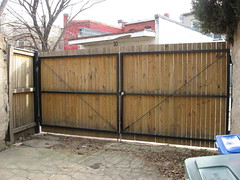
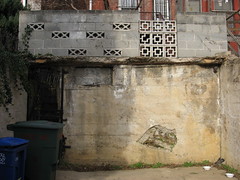
While the house is nice, I think its most interesting feature is the creepy back yard. Let me take you through the experience of coming home through the alleyway. I took these pictures during the day for illustrative purposes, but try to imagine going through this in the dark (which we often do this time of year).
Why would we come in through the alleyway? For one thing the parking space is back there (I'm still car-less, but K has a newly-sideswiped red station wagon), and for another, it's a shortcut to and from the metro--at least if you don't figure in the time spent locking and unlocking.
The first set of doors to lock and unlock are these, the doors to the parking space:
This brings you to a parking space lined with jagged-topped cement walls:

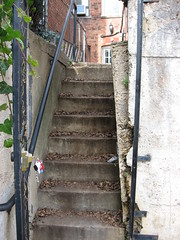
For extra creepiness, one of the more talkative feral cats will sometimes watch me from the top of one of the walls and meow. Next I unlock the deadbolt on the ivy-grown metal gate on the left; it groans as I open and close it. I step onto the first of the narrow cement steps:
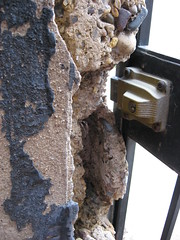
To lock the iron gate I have to put my hand into this jagged hole in the cement wall:

I walk up the stairs and into the leaf-strewn back yard:
There's often a feral cat or two crouching in the shadows watching me, but they run away when I get too close. I walk up the rusty metal stairs, opening and closing a second metal gate at the top and, finally, the house door.
In conclusion, if you're looking for a location for shooting your low-budget horror movie, I'm sure we can work something out. I should say, though, that the house's positive features include a big kitchen with shiny new appliances, reasonably spacious living and dining rooms, and a second floor (!) with two bedrooms, two bathrooms, and a balcony... that overlooks the back yard.
While the house is nice, I think its most interesting feature is the creepy back yard. Let me take you through the experience of coming home through the alleyway. I took these pictures during the day for illustrative purposes, but try to imagine going through this in the dark (which we often do this time of year).
Why would we come in through the alleyway? For one thing the parking space is back there (I'm still car-less, but K has a newly-sideswiped red station wagon), and for another, it's a shortcut to and from the metro--at least if you don't figure in the time spent locking and unlocking.
The first set of doors to lock and unlock are these, the doors to the parking space:
For extra creepiness, one of the more talkative feral cats will sometimes watch me from the top of one of the walls and meow. Next I unlock the deadbolt on the ivy-grown metal gate on the left; it groans as I open and close it. I step onto the first of the narrow cement steps:
I walk up the stairs and into the leaf-strewn back yard:
In conclusion, if you're looking for a location for shooting your low-budget horror movie, I'm sure we can work something out. I should say, though, that the house's positive features include a big kitchen with shiny new appliances, reasonably spacious living and dining rooms, and a second floor (!) with two bedrooms, two bathrooms, and a balcony... that overlooks the back yard.
Thursday, August 16, 2007
Pimp my cat
Correct me if I'm wrong, but I think this is Icanhascheezburger material. I just need the right caption. Ideas?
Thursday, January 04, 2007
Tuesday, July 25, 2006
To Drive Or Not To Drive
Today I got an auto insurance quote for D.C., and it wasn't pretty. Then I got some more quotes, and they weren't much better. So the question I'm thinking of just selling my car rather than spending oodles of money to keep it parked on the street all the time except for the 1-2 times a week when it seems more convenient to drive through D.C.'s notorious traffic and find parking than to just walk or take public transit. I can always rent a car for weekend excursions, right? To be honest, convenience comes in third in my reasons not to sell my car, the first two being:
1.) I really like Grommit, he's a very distinctive accessory, and I literally just paid him off (should be getting the title in the mail any day)
2.) It will be a pain in the ass to sell my car
Neither of which should really tip the balance toward the spending of oodles of money (not to mention time at the DMV!) to let a car languish by the curb.
Still, I'd feel better if I knew someone who'd give Grommit a good home. Anyone want to adopt a car? He won't be free to good home, but I might knock some off the blue book value for the right person...
Or maybe better insurance news will come in the morning.

Speaking of adoptions, Rocky is doing better. She's still hiding when I come home and not eating as much as she probably should, but she's acting much more like a sweet, affectionate, non-terrified cat. [TOWWAS: I remember telling you a long time ago that if I started a blog it would have to be about my cat. Case in point. Although to be fair, I would have included a picture of my car too if it weren't nine floors and a long, long hallway away. I didn't even have to get up to take a picture of Rocky.]
1.) I really like Grommit, he's a very distinctive accessory, and I literally just paid him off (should be getting the title in the mail any day)
2.) It will be a pain in the ass to sell my car
Neither of which should really tip the balance toward the spending of oodles of money (not to mention time at the DMV!) to let a car languish by the curb.
Still, I'd feel better if I knew someone who'd give Grommit a good home. Anyone want to adopt a car? He won't be free to good home, but I might knock some off the blue book value for the right person...
Or maybe better insurance news will come in the morning.
Speaking of adoptions, Rocky is doing better. She's still hiding when I come home and not eating as much as she probably should, but she's acting much more like a sweet, affectionate, non-terrified cat. [TOWWAS: I remember telling you a long time ago that if I started a blog it would have to be about my cat. Case in point. Although to be fair, I would have included a picture of my car too if it weren't nine floors and a long, long hallway away. I didn't even have to get up to take a picture of Rocky.]
Wednesday, July 19, 2006
Rocky
I really think a yellow Beetle has the power to incite goodwill in the hearts of man. Two cases in point, both drawn from this evening:
1.) I'd parked my car on the street on Sunday, and when I came to get it this evening I saw it was in an "emergency no parking area." Had been for two days. It was in front of a building that seemed to be in the process of being demolished, in fact, and there was a dumpster just behind my car. Yet Grommit had not been towed or ticketed.
2.) Upon reaching my destination I couldn't find legal parking, so decided to squat in front of a "diplomatic cars only: romanian embassy" sign. It didn't have hours posted, but I thought no one would need to park at the Romanian embassy at 8:30 p.m. However, as I got out of my car a guy came out and told me I couldn't park there.
"Not even for ten minutes?" I asked.
"For ten minutes, ok. But no longer," he answered in his (presumably) Romanian accent.
And you know what? I'm pretty sure I was there for 15. No ticket, no tow.
The occasion for which I broke out the car was to go meet a cat named Rocky. Until this evening Rocky lived with a guy who works on my floor and his family, but they got a new dog a while back that makes Rocky very nervous, and had decided the cat would be happier in another home, one with no dogs. I was forwarded an email to that effect yesterday afternoon, when I'd settled in just enough to start thinking seriously about acquiring a four-legged roommate.
Unfortunately Rocky, like most cats, does not like being transported. She (yes, Rocky is a she) meowed all the way home, and although I miraculously avoided getting lost on the trip, I seemed to hit every red light. She meowed as I walked a block to my building and down the long hallway to the elevator and into my apartment. When I put the cat carrier down in the walk-in closet and opened the door, she still stayed there meowing for half a minute or so. She was traumatized.

I closed the door of the closet, thinking it might be easier for her to get used to one room at first before exploring the apartment, and also not wanting her to escape when I opened the door. I went back down to the car to get the kitty litter donated by her former owner, and when I came back I found Rocky wedged into the corner of the closet as far as she could go. She meowed piteously, but I really didn't know what I could do for her; it was one of the saddest things I'd ever seen. So I took this picture. Then I decided to put a box in front of her to see if that helped her agoraphobia, and in fact she did stop meowing, though she's still got her nose in the corner. Poor thing.
1.) I'd parked my car on the street on Sunday, and when I came to get it this evening I saw it was in an "emergency no parking area." Had been for two days. It was in front of a building that seemed to be in the process of being demolished, in fact, and there was a dumpster just behind my car. Yet Grommit had not been towed or ticketed.
2.) Upon reaching my destination I couldn't find legal parking, so decided to squat in front of a "diplomatic cars only: romanian embassy" sign. It didn't have hours posted, but I thought no one would need to park at the Romanian embassy at 8:30 p.m. However, as I got out of my car a guy came out and told me I couldn't park there.
"Not even for ten minutes?" I asked.
"For ten minutes, ok. But no longer," he answered in his (presumably) Romanian accent.
And you know what? I'm pretty sure I was there for 15. No ticket, no tow.
The occasion for which I broke out the car was to go meet a cat named Rocky. Until this evening Rocky lived with a guy who works on my floor and his family, but they got a new dog a while back that makes Rocky very nervous, and had decided the cat would be happier in another home, one with no dogs. I was forwarded an email to that effect yesterday afternoon, when I'd settled in just enough to start thinking seriously about acquiring a four-legged roommate.
Unfortunately Rocky, like most cats, does not like being transported. She (yes, Rocky is a she) meowed all the way home, and although I miraculously avoided getting lost on the trip, I seemed to hit every red light. She meowed as I walked a block to my building and down the long hallway to the elevator and into my apartment. When I put the cat carrier down in the walk-in closet and opened the door, she still stayed there meowing for half a minute or so. She was traumatized.

I closed the door of the closet, thinking it might be easier for her to get used to one room at first before exploring the apartment, and also not wanting her to escape when I opened the door. I went back down to the car to get the kitty litter donated by her former owner, and when I came back I found Rocky wedged into the corner of the closet as far as she could go. She meowed piteously, but I really didn't know what I could do for her; it was one of the saddest things I'd ever seen. So I took this picture. Then I decided to put a box in front of her to see if that helped her agoraphobia, and in fact she did stop meowing, though she's still got her nose in the corner. Poor thing.
Subscribe to:
Posts (Atom)