skip to main |
skip to sidebar
 [Written on October 5]Arrived on the afternoon of the third, and have felt overwhelmed to some extent since my plane rolled up to the gate, The journey was about as comfortable as a 13-hour flight in coach can be; I think I'm a fan of Air Canada. The difficult part was getting up at 3:30 am to catch a plane to Toronto, only to wait in the airport for five hours.I left the Beijing airport on an impressive high-speed train and transferred to the subway with no problems. I have only myself to blame for the series of unfortunate events that commenced once I got off the subway, since I had forgotten to print the confirmation email I received when I made my hostel reservation, or even to read it closely enough to realize that the hostel I thought I was reserving at no longer existed. Apparently the Beijing Gongti hostel had been kicked out of the Worker's Stadium and reincarnated as the Golden Pineapple Hostel somewhere nearby.But I was not to learn this until I checked my email the next evening. At the time, I tried relying on Lonely Planet, signs near the Worker's Stadium (on these the hostel still existed), and asking people who worked around the stadium, not one of whom had ever heard of the place. Most of them were determined to help me, though, which led to much wasted time. one exceptionally kind woman, who spoke not a word of English, led me at my request to a shop to use the telephone. the phone was in use, so she took me to a second shop, where I tried calling the hostel--no answer. Then she discussed my predicament at length with other shop patrons. Then we went back to the stadium park, and I pointed out to her on the map at the gate where the hostel was supposed to be. I'm pretty sure she didn't understand this, just as I understood next to nothing she said, except when she commented that finding this hostel was really not easy. I agreed wholeheartedly.Then she explained her plan, which I understood not at all, but it seemed easier to follow her than to try harder to extricate myself from her leadership. I'd tried to extricate myself already, thanking her when we arrived at the shop with the phone, and trying to explain afterward that I was just going to go back to the park and look some more, but to no avail.The new plan took us out of the park, past restaurants that included an Outback Steakhouse, and far away. I felt increasingly desperate as we grew further from the stadium, with its signs that assured me the hostel was right there, but I was strangely resigned to my fate. The intense physical discomfort that came with wandering Beijing with a pack hardly had meaning anymore.After 10 minutes or so we came to a sort of shopping center, where my guide looked at the list of businesses. Of course, the hostel wasn't on it. I'd been holding out hope that she was leading me to an alternative hostel, but this was clearly not the case. She asked an older couple walking by about the hostel, and everyone looked at the map in my Lonely Planet book for the umpteenth time that night. The old couple pointed out the obvious, which was that this hostel was by the stadium.We started back. In an effort to avoid walking and regain some measure of control over my own destiny, I hailed a cab. I tried to offer my guide a lift, since presumably she was returning to the stadium grounds as well, but she probably didn't understand where I was going, and didn't get in. The driver didn't understand either, and dropped me off a few blocks later. But at least I'd saved a few blocks of walking.I went back to the park and looked some more, until it truly seemed impossible that this hostel existed. Then I went to a hotel I'd seen while we were on our way to the shop with the phone. It cost more than twice what I'd have paid at the illusory hostel, but that was still only about $50. To say it was worth it would be an understatement.My first Chinese lesson: Be careful whom you ask for help.
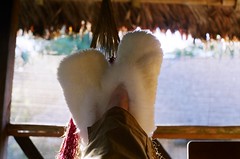
About the photograph: No, I did not open the 25 yuan package on my hotel nightstand to see how the vibrating condom worked. Anyone who knows is encouraged to comment (anonymously, if necessary).
I woke up early--I'd slept in short spurts all night long--and set off in search of another Lonely Planet-recommended hostel in the neighborhood. This one seemed to have ceased to exist as well, but I'd seen signs for another hostel the night before, and this one I eventually found. I moved, then set out for the Forbidden City and Tiannanmen Square.The square was still decorated for the Olympics--I enjoyed seeing the Olympic mascots miming various sports. Lines of soldiers marched purposefully here and there, and Mao's portrait beamed down benevolently on us all.I worked my way into the Forbidden City eventually and was suitably impressed. Apart from the main courtyards, my favorite parts were the exhibits of various treasures, like the empress's hair pins.My tired feet and the subway bore me back to a street near the hostel, where I had my first real meal in China, a tofu-vegetable dish from which I carefully removed the pork.My hunger sated, I felt overwhelmingly sleepy and had to force myself to check email and read for a few hours before passing out at around 8:00.
 Went to the Lama Temple, where there were many people praying among clouds of incense. Was strangely underwhelmed until I wandered into an exhibit of sculptures of strange, Indian-looking gods.
It was raining a little. I walked around nearby hutongs for a bit, then down an important street past a Ming-era center of Confucian learning. I feasted at a somewhat pricey vegetarian buffet on the same street; though it was obviously geared toward tourists, I took comfort from the fact that most of the tourists were Chinese.
It had occurred to me while I was at the Lama Temple that I wasn't really in the traveling mindset yet. And why not? Maybe because I hadn't seen anything really surprising yet, with the possible exception of Beijing's sparkling subway system. I needed to find something weird. After lunch I set out to buy a ticket for a kung fu show, another wild goose chase I won't go into other than that I finally did find the Chaoyang Culture Center, it apparently no longer hosts kung fu shows. Clearly the Beijing described in my Lonely Planet--published in spring 2007--was not the Beijing of October 2008.
I caught a taxi to the Pearl Market next and tried out my haggling skills on a windbreaker. The experience taught me that my haggling skills needed work. I didn't stay at the Pearl Market for long--not weird enough, and it seemed sensible to leave the shopping to the end of my trip. So I crossed the pedestrian bridge and entered the park surrounding the Temple of Heavenly Peace.
There for the first time, I felt myself really getting in to the traveling groove. People were singing in a huge group; others were playing a game with ping pong paddles but no table; down a little further people were playing instruments; further still, there were women with red spangled scarves around their waists dancing to recorded music. In more secluded spots among the trees people stretched and practiced tai chi. It was lovely and strange.
I wandered the park until dark. A sign claimed that some of the cypresses in the park (the park where the emperors used to come to pray for big harvests) were 800 years old. Here's a country Americans tend to think of as recklessly destroying its environment, yet in the heart of Beijing it's harbored trees through several dynasties and foreign invasions, a civil war, Communism, the Cultural Revolution, capitalism, and the city's famously polluted air.
At dark I headed to the famous snack street, but skipped the fried bugs on sticks--the weirdest thing I ate was fried ice cream on toast. The area the snack market is in seems like Beijing's answer to Times Square. In fact many parts of Beijing--those that I saw, anyway--were bigger, newer, and cleaner than the nicest parts of American cities. After snack street I turned in early once again, but this time with good reason: My bus to the Great Wall was to leave at 6:30 am the next day.
 On October 6 I went to the Jinshanling section of the Great Wall with a bus bull of backpackers who'd booked the trip through our various hostels. It was a 3-hour drive each way to this less-trafficked section of the wall. We walked from there to the Simatai site, 10 km away. It was great to breathe fresh air again and see the wall, and it was a perfect sunny day. But it was another essentially unsurprising activity.Back in Beijing I collected my backpack from the hostel and headed to the train station. I'd booked a ticket through my hostel, and only "hard seat" class spots were still available--the hostel worker explained that this was because people were returning home after the October 1 holiday week. When I'd read about hard seat in books about China I'd pictured a bench, but these were actually lightly-padded seats with non-reclining backs. I fell asleep almost immediately, and slept for much of the 12-hour trip, but woke up with quite a sore neck.
 It was foggy and rainy in Shaanxi province. I'd made a reservation for once, and got a shuttle from the station to the hostel. Feeling like a new woman after a shower and breakfast, I set out to buy my next train ticket and see the terra cotta warriors. I managed to use my Chinese to buy a "hard sleeper" ticket for the next day, and left the train station feeling quite proud of myself, even though I was to leave at 13:20 instead of in the evening, as I would have preferred.I walked in front of the train station looking for the shuttle bus to the warriors museum. There were huge puddles everywhere and I accidentally stepped in a few, wetting my feet through my sturdy hiking shoes. But I didn't wander long before a bus conductor saw me and pointed out the bus to me. I'd ridden a taxi to the train station and bough a ticket in Chinese, then found the correct bus, all in 20 minutes or so--my confidence in my travel skills was beginning to return.I'd seen the warriors museum on the Travel Channel just a few months before, so it seemed an unlikely candidate for a site that would surprise me. But I found the warriors' expressive faces and broken, jumbled bodies (in the partly-excavated sections) strangely moving, as if they were real people who'd been interred here alive. In fact they do represent the exquisite life's work of countless nameless artisans, buried pointlessly for milennia thanks to an emperor's delusion of immortality.After a few hours with the warriors I took the bus back to the city. It was about 6:00 when I arrived, and cold. I was very hungry. I walked down a major street for awhile without seeing anything remotely appealing, then spotted a restaurant on a side street. It didn't look like the kind of place that got many waiguoren, but I went in anyway.One of the waitresses opened the door for me and asked how many people I was. This seems to be a mandatory question at restaurants in China, even when, as then, there's no one else around. I don't know whether it's an immutable rule that it must be asked, or if people are simply incredulous that anyone would go to a restaurant alone.My apprehensions were confirmed when I got the menu: It had no English, no pinyin, and no pictures. The waitress patiently awaited my order as I whipped out my tiny dictionary, but clearly nether it nor I were up to the task of decoding that enormous menu. I decided to throw myself on the mercy of the waitress, even though she hadn't understood me the first time I asked for tea.In Chinese, I explained that I don't eat meat, that I like vegetables and tofu and mushrooms. She aksed whether I liked spicy food, and I said no. There were other questions that I tried to guess at and muddle through. I said yes to rice.And voila! A dish of tofu, mushrooms, onions, and peppers appeared a few minutes later, sans meat, with rice. I was incredibly awkward in Chinese, but maybe I could get by after all, I thought.I turned in early again. This time my excuse was that I'd been on a train the night before. Besides, if I was to leave at midday, I wanted to get an early start.
I got a reasonably early start on the 8th, though I was slowed by some difficulty finding breakfast. I was determined not to eat in my hostel, on the grounds that it was overpriced, smokey, and too backpacker-y. But the coffee shop I found wasn't open yet, and street food just wasn't as ubiquitous as I'd expected. So... I settled for toast and scrambled eggs in the hostel next door, which turned out to be much prettier than mine. At least my quest led me through a strip of park that runs along the outside of the city wall, where early risers were socializing and exercising.After breakfast I ascended the city wall at the South Gate and rented a rickety bike, then jounced in a rectangle around the central part of town. It's an impressive wall in terms of size, condition, and pretty sentry buildings and watch towers, but once you've seen one strip of it, you've seen it all. It was interesting to get a look at the slums, since I'd only seen the nicer parts of Xi'an to that point.I used all 100 minutes of my bike rental to get all the way around (it was a long wall, and a rickety bike), then got a taxi to the town's big, ancient mosque. It was a very Chinese-looking mosque complex, and though it looked to be in good condition it had a dusty patina, which I liked. I was disappointed that only worshipers were allowed in the prayer hall, though I understood it. Short on time, I stopped at several tiny shops in the Muslim quarter for provisions: several pieces of bread, some unidentified fruit, a preserved egg, pastries. I got a taxi back to the hostel, collected my backpack, and took a taxi to the train station.Yes, I took a lot of taxis in China. It's lazy, but it's hard to justify trying to brave the bus system when someone will drive me where I want to go for a little over a dollar. I am on vacation. But taxis don't solve every problem: The drivers don't speak English, have never heard of my hostel, and didn't understand it I try to tell them the address. A Lonely Planet map (with street names in pinyin and characters) means nothing to them. So I coped by telling them a landmark near where I want to go, then walking. Eventually I started painstakingly copying addresses from Lonely Planet onto a small piece of paper, which they seemed to understand better than my spoken Chinese.The 16-hour train ride was uneventful and fairly comfortable, with one scenic mountainous stretch before it got dark. I think there was meat in one of the pastries I'd bought, but the others were good. The dried fruit turned out to be crabapples, I thought--I couldn't remember ever having eaten a crabapple, so I couldn't be sure. The preserved egg tasted ok, but looked black and gelatinous and had a chemical smell. When I got to the yolk it was slimy, and I actually gagged. I threw the rest away.I woke up sometime after 4:00 am and found the other three passengers from my compartment gone. I worried that I'd missed Chengdu, and stayed awake to make sure I wouldn't, if I hadn't already. In fact the conductor would have woken me up; she'd collected my ticket earlier, carefully folded it three ways, and pu7t it in a pocket in a book, handing me a plastic rectangle with my car and compartment numbers. This ritual was repeated in reverse shortly before arrival.
The train pulled into Chengdu at 5:30 am. At the taxi stand I was besieged with offers of a ride, but didn't realize the touts weren't official taxi drivers, but freelancers. One told me he'd take me to the Wenshu Temple (which was supposed to be near my hostel) for Y40, which I knew was ridiculous. I settled on Y15 with another, only to discover that his "taxi" was a motorcycle. No way was I getting on a motorbike at 5:30 am in a strange city, particularly not with my pack. I got to the temple in a real taxi for Y10.I found the hostel with no problem, but there found my punishment for changing my lodging plans while on the train (choking on fumes, I'd decided it was critical to find a nonsmoker-friendly establishment). A sign informed me that the hostel had relocated, but notes were thoughtfully provided to direct taxi drivers to the new place. Sticking to the path of least resistance, I took a taxi to the new place. This turned out to be a good choice: Sim's Cozy Guesthouse is an oasis, cheap but comfortable and clean, with all the services a weary budget traveller could ask for.I showered, breakfasted, and bought a plane ticket to Lijiang to leave Sunday evening. I bought a map and rented a bike and went back to the Wenshu Temple, which I explored thoroughly before feasting in its vegetarian restaurant. Then I walked along the streets in front of the temple, which are picturesque and touristy.An old man with a smooth, friendly face and a cowboy hat stopped me on the sidewalk and asked where I was from. He told me he would give me an American history lesson. His strong accent and many missing teeth made it a hard lesson to understand, but the gist was that in 1943 Roosevelt sent airmen to Chengdu to fight the Japanese. People walking by turned to look at us curiously. The old man asked me where I was going in China, and made a comment about Xi'an that I didn't understand. Then he said goodbye.I pedaled south to the giant Mao statue and admired the new subway station in the square in front of him. The next stop was the thatched cottage of Du Fu, a Tang dynasty poet. His actual cottage is long gone, but hundreds of years ago an admirer built a new cottage in the same area, and subsequent dynasties have maintained and added to the cottage. Not a bad way to venerate someone, I suppose.This was clearly a major tourist attraction, and I was impressed that the Chinese had so much love for their poets. The only equivalent I could think of in the Anglophone world is Stratford-on-Avon. I resolved to read some of Du Fu's work back in the States.I stopped in at the site's tea garden and was reading when a man came by my table and asked whether I was English. American was good enough--"you speak English, anyway." He was an overweight man in his 50s with a Chinese woman. She was well-dressed with fashionable glasses, perhaps 20 years younger than him. He asked me whether this was my first time in China and what I thought of it, and I said it was great but overwhelming, which was the prelude he needed to launch into a near-monologue about how China is better than England because it's cheaper and the people are friendlier and the women are "superior" to English women, because they won't argue with you. Also Chinese is the hardest language for English speakers to learn, but when he gets back to England he's going to put "her" into an English class, because it's much easier for a Chinese woman to speak English. "They're quite clever, you know. They're not as stupid as we think." I wondered whether my nodding could be taken as agreement that I thought the Chinese were stupid, or that they actually were clever. When he talked about liking women who won't argue I did say something like, "If that's what you're into," but I'm not one to pick fights with strangers in tea houses.I watched him waddle off with his mail-order bride, or whatever she was, after they'd showed me their electronic translators (his black, hers pink and white), and marveled that anyone could be so obliviously offensive. But his colonial outlook seemed so anachronistic in the China I saw that I couldn't get worked up about it, but somewhat grossed out.I headed back toward the hostel post-tea, but managed to get a little lost. I think it took about an hour and a half to get there. Given my now-vast experience with bicycling in China, I will here record some principles:- Adopt an unshakable Zen mindset. Take nothing personally, and let nothing startle you.
- American ideas about right-of-way mean nothing. Pay attention to red and green lights, but treat them as suggestions.
- If you see an opening, take it.
- If you and another person go for the same opening, the one in the smaller vehicle yields. Bikes yield to everything but pedestrians.
- Keep in mind that there's safety in numbers. Do as the other bikes do.
Another early night. China overstimulated me with sensory information and with the depth of my own non-understanding. It also overwhelmed me with people, which might be why I became so introverted there. That day I was also having doubts about what I was accomplishing by traveling, doubts I'd had before. Since I can only hope to gain the most superficial understanding of a culture by wandering through a country for a bit, unable to speak the language, what's the point? I might as well be going around on a tour bus collecting pictures of myself with the Great Wall and the Tower of Pisa, or better yet, home watching the Travel Channel.Yet the world still beckons. A superficial first-hand understanding seems superior to mere research.
From Chengdu I took a day trip to Sanxingdui, a site perhaps an hour away via two fuses. It's two museum buildings on the site of a 20-year-old archaeological dig. There's a very impressing collection of pottery, jade, and bronze artifacts that are like nothing that's been unearthed anywhere else, as far as I could glean from the exhibits. I spent a few hours there, fascinated.Back at the Chengdu bus station I headed for a nearby monastery to try to get a late lunch at its vegetarian restaurant, which Lonely Planet claimed was open until 3:30. I arrived at 3:15 to find it shuttered. I was famished but took a walk around the monastery anyway (it's called Zhaojue). Nice place, but all the monasteries were beginning to look much alike by now. This one was distinguished by an ugly concrete pond full of small turtles. I'd never seen a higher concentration of turtles outside of a Dr. Seuss book.Two giggling girls, perhaps 13 years old, ran to to me and asked a question, holding up a camera. I nodded, assuming they wanted me to take their picture, but of course they wouldn't have chased down the one foreigner in the place for that. The excitedly took turns taking one another's picture with me. Then they were off, with a chorus, of "xiexie, sank you!"I wasn't sure what to make of this, but the girls were too cute and enthusiastic for me to regret having said yes. I said yes to all future picture requests, so I'm probably immortalized on Chinese Facebook pages as the giant, freckled foreigner with the crooked smile.Famished, I walked back to the bus station, determined to catch a city bus back to the hostel. But after going to the trouble oflocating the buses, and then the right bus, I discovered that the smallest bill I had was Y50, which I was sure wouldn't fly for a Y1 fare. So I went to the taxi stand. The first taxi I got in rear-ended another car on the way out of the lot. I got out which the driver was talking to the inhabitants of the other car and got into a different taxi. I'm pretty sure that's where I lost my fleece, in the back seat of the unfortunate cab. I liked that fleece. All because I didn't have Y1.I ate an enormous amount of ostensibly Sichuanese food in the restaurant of Sim's hostel, laid down for a bit, and then went to see a Sichuan opera. It was touristy by excellent, with music and puppeteering and flamboyant costumes and face-changing and fire-spitting. I'd been particularly interested in seeing the acrobatics, which were not what I expected: A pretty young woman laid on her back with her feet in the air and deftly turned and tossed first a pot, then a table, with her feet.Back at the hostel I turned on CCTV International, China's state-run English station, as I got ready for bed. I'd become somewhat addicted to CCTV, partly for comforting background noise but mostly for its window into the government's perspectives and preoccupations. The brief roundup of the day's new reported that Obama was ahead of McCain by 11 points, which made my jaw drop. It wasthe first election news I'd heard since arriving.
I took the bus two hours from Chengdu to Leshan to see the giant Buddha. It's supposed to be the biggest Buddha in the world, or even, according to something I saw, the biggest stone carving.The place was swarming with tourists, mostly Chinese tour groups who mobbed the area to the side of Buddha's face to take pictures. There were other things to see on the top of the mountain, like a tall pagoda and yet another temple. I was hungry and bought a little 5 yuan bowl of noodles. It was hot enough that my eyes watered profusely and the noodle-stand women laughed gently at me. Several people asked to take pictures with me while I was there; there were only a handful of other Westerners.The Buddha was big. No surprises there, but I'm glad I saw it.As I left the site a man asked whether I was going to Chengdu and hustled me onto a minibus that would meet the big bus along the road. I was happy to be saved the effort of getting to the bus station. While we waited for the big bus the middle-aged Chinese couple who were the only other minibus passengers tried to talk to me. The woman spoke a little English. They said America was a nice country, and I said China was very interesting. Later, after the bus made a stop at a gas station with a fruit stand, the woman gave me an orange.The bus left us at a station on the far outskirts of town, not the same one I'd left from. I couldn't figure out where I was or even how to take a taxi--none of the drivers were in their cars, although one woman told me she'd take me where I wanted to go (I'd written down the address of a restaurant) for 30 yuan, which sounded like far too much. Finally I got a cab driver who would turn on his meter; it cost 20 yuan, but the restaurant Lonely Planet had recommended so highly seemed no longer to exist. The person who invents a combination pocket translator and deliverer of travel information that's actually up-to-date will deserve to be very rich.I saw a few Western restaurants and even an Indian place, but was determined to get some good Chinese food. I stopped into a place that looked fairly upscale, but I'd miscalculated: The menu wasn't in English, and there weren't really any vegetarian dishes. The first woman who tried to wait on me gave up in frustration. Then a young guy tried, and I randomly pointed to one of the dishes he said was a vegetable dish. It turned out to be a plate of broccoli--excellent broccoli, and served with rice, but not nearly enough for my empty stomach. Defeated, and feeling like one of the characters in Lost in Translation, I crossed the street and entered the Shamrock Pub.At least half of the patrons were foreigners, and normally when traveling I become more gregarious. But even there I didn't talk to anyone except the waiter, just ordered an excellent "mocktail" and a flavorless vegetarian pizza, read, scribbled in my journal, and left before the live music started. If I kept up my antisocial ways, I thought, the nonstop schmoozing of the conference I'd soon attend in California would be quite a shock to my system.
On Sunday I resolved to do nothing in particular. I had a leisurely breakfast of fruit in my room and packed to the sound of CCTV. I called my great-aunt Lily, a task I'd neglected to take care of before coming to China. Lilly lives in San Jose, and I was planning to stay with her in a couple of weeks. I thought I should give her a heads-up. Hers was the first familiar voice I'd heard since leaving the States.Next I called the cell phone for the Wenhai Ecolodge, a place I'd found a few months before when I Googled "Yunnan ecotourism." Going to an ecolodge in the jungle had been the highlight of my time in Peru, and I hoped there were similar opportunities in China. I'd made an email reservation with someone who seemed to speak English quite well, and now needed to work out how to get to the lodge. My options were hiking, horseback, or Jeep; I chose horseback. My pack was nice enough for jaunts around towns in search of hostels, but I'd never hiked with it, nor did I want to try. And having someone drive me up a mountain in a Jeep didn't seem very eco-friendly.After taking care of a few other things I rented a bike and rode to what seemed to be Chengdu's main tourist shopping drag, a place with nice dark wood buildings. It adjoined a park where I went wandering, and confirmed my impression that going to the park is one of the best things to do in China. I saw an old man painting calligraphy on the paving stones with water and a giant brush. This in addition to the usual newspaper-reading, tea-drinking, and music-making.I did have a destination in mind in the park, namely the Green Ram Taoist temple and its vegetarian restaurant. It's interesting how similar the Buddhist and Taoist temples look to my untrained eye. The main differences I picked out are the ubiquity of the yin/yang symbol (only Taoist), and the way the monks dress.At the temples, I've seen monks chanting and people reverently lighting incense. I've also seen monks chatting on cell phones and hawking loogies, and woman kneeling to pray in a pink velour tracksuit with "Juicy" printed across her ass. It would be nice to get a tour of a temple sometime from someone knowledgeable, but until that happens, I'm not keen on going to more temples anytime soon.At the restaurant, the waitress put a menu in front of me that looked like it might have been a relic of the Tang dynasty, if they'd had typewriters in the Tang dynasty. The edges of the pages were ragged. But I noticed later that the other patrons had nice menus with hard covers and laminated pages, and figured the waitress had given me the antique version because it was bilingual.I was grateful for this, but it didn't completely solve my communication difficulties. When I pointed to a dish described as "pumpkin," the waitress tried to explain why I might not in fact want it, but I didn't understand. So she helpfully went and got the vegetable in question and showed it to me. I looked like an extremely warty cucumber. I nodded--I was in China to try new things, right?--but it turned out to be the most bitter vegetable I'd ever tasted. Fortunately I'd also ordered a tofu dish. I was beginning to catch on that even if you're a lone diner, and you know that Chinese portions are huge, you don't order just one thing at a Chinese restaurant.Afterward I found my bike--this took a little time--and went to the People's Park in the heart of the city. This one has kiddie rides, full bands giving free concerts, and a garden of Bonsai trees. It also has a famous teahouse that I wanted to try. The teahouse is huge and sprawling, set on a small lake where families rent paddle boats. Men walk around tinging their ear-cleaning instruments (a sound much like a triangle) to advertise their services. I finally agreed to a 20-minute massage from one.He focussed mostly on my arms, gripping them so tightly at times that I thought I might bruise (I didn't). He also massaged my shoulders and back, my scalp, and even my forehead. I felt ridiculous getting my forehead massaged in the middle of a crowded teahouse, but the liberating thing about being a stranger in a strange land is that just about everything I do will seem odd, so why not?On the way out of the park I admired a topiary structure of what appeared to be a dragon and a rooster going after a ball at the same time. A trio of pandas seemed to be in the works, but at the time they were just skeletons.I biked back to the hostel without getting lost, and had about 20 minutes to spend online before taking the airport shuttle. While in China I mainly went online to triage my email and update my Facebook status lines.An American named Josh was the only other person taking the shuttle from the hostel (we picked up one other person, a Chinese guy, on the way). It turned out we were on the same flight. We had other things in common too, like having been in China for about the same amount of time and having gone many of the same places there, being vegetarian, and having lived in DC, New York state, California, and the Southwest. But it was a long ride to the airport, and by the time we reached the departure lounge the conversation was flagging. Despite his very American friendliness there was something about Josh that annoyed me, perhaps a subtle sense of his own superiority, and I was ready to be alone again.At baggage claim in Lijiang, Wangning and Henry asked if we'd like to share a taxi in from the airport, which we did, piling our backpacks in the middle seat of a van and exiling Josh to the front seat while the other three shared the back. Wangning is Chinese and Henry German; they met at college in Berlin. Wangning had been back for a year and was showing Henry around the country. I liked them.The driver was unwilling to take Josh and I to our hotels in the Old Town, and so dropped us off at a taxi stand somewhere in Lijiang. Getting to the room I'd reserved at Mama's Naxi Guesthouse turned out to be no small feat. I'd been feeling very comfortable in China after my half-day of parks, tea, and massage, but was thoroughly tired, hungry, and grouchy by the time I found my lodgings. Even so I couldn't help but find the Old Town charming, with its narrow, carless cobbled streets, graceful buildings, and canals.
I woke up early to the sounds of a cat crying insistently and of a German tourist telling the hostel worker her plans. Leaving my window open had been a mistake.I gave up sleeping eventually, and showered and packed. The woman who worked there was no longer in the courtyard when I came out. No one had asked me for money the night before or even my passport, but no matter--Mama's Naxi Guesthouse was actually three guesthouses, and breakfast was served at a different one. I had a banana pancake there, actually a large piece of flat fried bread covered in sliced bananas, and paid for both the pancake and the room.I was supposed to meet Cun Xuerong, the ecolodge manager, at 10:00 at a water wheel on the other side of the Old Town. My experience the night before had taught me that the Old Town is very difficult to navigate for the uninitiated, but miraculously, I arrived at 10:00 exactly. Mr. Cun, a handsome 30-something man with an urban air, found me quickly. He doesn't speak English, it turned out. I expressed surprise, since the emails from Wenhai had been signed with his name, but he said someone else had written them. The woman I'd talked to on the phone, surely.We managed to communicate surprisingly well in Chinese, though. Perhaps Mr. Cun is used to talking to foreigners with a weak grasp of the language. Was I American? Yes. Was I working in China? I'd learned the word for "work" but forgotten it. I looked it up, then told him I didn't have a job in China, but was a tourist. Where had I studied Chinese, then? In college. Mr. Cun seemed pleasantly surprised to hear that colleges in America offer Chinese. He asked whether the instructors were Chinese or American. I said they were Chinese. It was by far the most successful conversation I'd had in Mandarin since arriving in the country.Mr. Cun drove me in his Jeep to the foot of a mountain, where we waited for the guide and horse(s) to arrive. When I'd asked for the horse option I'd optimistically expected a guide on a horse, a horse for me, and perhaps a third animal for luggage, but now I worriedly watched a middle-aged man lead one small, dark, slightly mud-speckled horse out of the woods. Mr. Cun introduced me to Mr. He and told me to put my backpack on and mount the horse, which I did with some difficulty. The saddle was what I assumed to be the Naxi traditional style, unpadded with a hard loop of a handle in front.I didn't particularly like being the tourist led along on a horse, but on our way up the mountain we saw Han tourists doing it too, and one middle-aged waiguoren couple. The path was steep, and the horse had to stop periodically to catch its breath. It wasn't long before my knees were stiff, my backside was sore, and I wished I were walking.Mr. He is perhaps about 40, and small. He wore a battered sport coat, corduroys, and shoes resembling soccer cleats, plus a backpack with the vegetables Mr. Cun had bought for my meals. He didn't talk much.We passed a dam, then a small reservoir. We crested the pass and soon afterward Mr. He suggested that I walk for the next stretch, which was particularly steep. I did so gladly, although my knees were so stiff I could barely walk at first. My dismount was no more graceful than my mount--I wasn't feeling like much of a martial artist.Further down he had me get back on the horse, which moved away as I did. I joked that he didn't like me, but it wasn't really a joke.As we neared the village we began to pass Naxi who weren't leading tourists on horses. Mr. He talked to all of them in a staccato language. We arrived at around 1:00, and Mrs. He cooked me lunch. It was simple and excellent: one plate of tomatoes and scrambled eggs, another of mushrooms and garlic, plus, of course, rice from a giant cooker.But it soon began to seem to me that there was something off about the ecolodge. Mr. Cun had told me, when I asked him, that there were no other guests at the moment, and I hadn't expected luxury accommodations. but I had expected some sort of orientation. The Hes spoke no English, and the English-speaking woman I'd spoken to on the phone was nowhere in evidence. I'd have settled for a printout suggesting things to do, or even a patient explanation in Chinese and sign language, but it seemed that once I'd been shown my room and fed, I was on my own. Also, there was a distinct atmosphere of neglect: Huge cobwebs in the bathroom and hallways, plastic bottles piled under the stairs, and a receipt left in my room from the Grand Lijiang Hotel dating from early September.Yet there was ample evidence that much care had gone into this place at one time. In the common room, where I ate, a sign announces that the lodge had been launched with funds from the Nature Conservancy and the Japanese government. The Nature Conservancy wanted to foster sustainable tourism in China to benefit the environment, and the Japanese wanted to show their friendship and help the people of Wenhai. Big framed posters, now dirty and faded, declaim in Chinese and flawless English on the philosophy of ecotourism, life in Wenhai, and regional flora and fauna. There are clipped articles on the lodge from the travel sections of the Daily Telegraph, the Far Eastern Economic Review, and the New York Times. These last two were both written in 2004 by the same freelancer, Craig Simmons. The articles sunnily describe the beauty of the setting, the difficulty of reaching the lodge, and its ecological amenities, which include solar panels, a biogas system, and a greenhouse. I wondered whether any of these were still working.It was only 2:00, so I decided to do a little exploring. On my way out Mrs. He asked where I was going, and I answered truthfully that I didn't know. Perhaps I should have tried to provide more information.I ambled around Wenhai Lake, which I'd learned is a seasonal lake, although I'm not quite clear on when it disappears. The only wildlife I spotted was a toad, but there were more free-roaming domestic animals than I'd ever seen before in one place: pigs, chickens, dogs, horses, cattle. I even saw some yaks, the first I'd ever seen outside of a zoo. The lake, the tiny streams that feed it, and the mountains--especially Jade Dragon Snow Mountain--made for some beautiful views. Time seem to melt away: Every time I looked at my watch, another hour had elapsed.I got back to the ecolodge as it was growing dark, and Mrs. He served me three dishes this time, plus the ubiquitous tea (with a huge thermos for refills). As I was eating Mrs. He came in and handed me a cell phone. It was the English-speaking woman I'd talked to the day before. I don't know what she sounds like in Chinese or Naxi, but in English she comes across as strident."Hello? How are you?" with preliminaries out of the way, she asked me what I planned to do the next day. I said I didn't know. She told me I could walk around the lake and village by myself, but to go further afield I would need a guide. I didn't argue about that. She said that my options for the next day included climbing a mountain or walking to some Yi villages. Weighing this, I asked how far away the villages were. "Two are close, but two are farther away. But if you get tired you can just tell the guide, he'll take you home." I asked how difficult the climb up the mountain was. "If you get tired, I think you can tell Xiao He "hui jia," or you can speak to him in English, because he has guided many foreigners and I think maybe he understand you." This response seemed unecessarily patronizing--of course I could tell Mr. He "hui jia"--but if could communicate so well with the Hes, why was she calling me? I said I'd like to visit the Yi villages, and handed the phone back to Mrs. He.The temperature dropped quickly after sundown, and the lodge was unheated, so I headed upstairs soon after dinner, taking the massive thermos with me. Next to my room was a door to the roof, and I went out. Here were the famous solar panels, or two of them anyway. One had a towel drying on it. On the wall were what appeared to be the panels' control or monitoring devices, but their digital displays were dark. Just to the side of the roof was a greenhouse I'd read about on an informative poster in the bathroom. In addition to nurturing vegetables, it was supposed to keep the biogas digester warm in winter so that it would keep working. But its clear plastic roof was almost entirely torn away, and the floor had been reclaimed by weeds.I was sitting in bed reading about the Naxi in Lonely Planet when Mrs. He knocked at the door. I found her very difficult to understand. She asked whether I had a question or problem. I said no. She said something about the phone call. I tried to say yes, the woman on the phone and I talked about my going to the Yi villages tomorrow. She asked me something that I didn't understand. She said never mind, go back to sleep. Confused, I went back to bed.
I woke up late and went down to take a shower in the cobwebbed bathroom that Simmons described as "shared but clean" (it was neither shared nor particularly clean at the moment). There was no hot water, where depressed me. Not because I couldn't shower, which didn't seem too important in a place this remote, but because the water was supposed to be heated by the solar panels. I stood shivering in the concrete bathroom, with its bilingual posters on sustainability, and decided there was no way I could stay there for the three nights I'd reserved.At breakfast I asked Mr. He for the cell phone, and told the English-speaking woman I'd like to leave the next day. She didn't ask why or seem disappointed, just asked how I'd like to get down the mountain. I said I'd like to walk but have the horse carry my bag. She said sure, and would I like to go the same way or take a different route down the mountain? I chose the latter.Mr. He and I set off after breakfast (dumplings and shredded potatoes). I'd thought there were no shops at all in Wenhai, but on the way out of the village Mr. He bought something at a window in a cinder block building. Certainly people find a way to buy things there, judging by the snack wrappers and beverage containers that litter the paths. Probably there isn't much of a trash-disposal system there.We passed through one tiny Yi village where no one was about. Before we even saw the second village I heard gun reports periodically, which echoed from the other side of the valley like soft thunder. Closer in I thought I heard firecrackers, too. But it was the middle of the day.As we got closer still I saw a large group of people gathered on a path above the village. The shots were being fired into the air from a field next to them. There was cheering and laughter. Further up the hillside a yak was tied to a tree.I asked Mr. He what was going on, and he said it was a "si le." This wasn't in my dictionary, but I assumed it meant a wedding. He pointed to the yak and drew the blade of his hand across his neck to indicate it would be killed.In the village proper a trio of children stared at me, and I stared at two old women in bright colors and hats that had a large black-draped flat rectangle. The hats reminded me a little of the Flying Nun, or maybe of large graduation caps. I could see that the women at the wedding were dressed the same way.Mr. He and I took a break on a pile of timber off the village's main drag, where we watched the festivities from a distance. In addition to the shots and firecrackers and laughter, there was a strange howl-like singing going on. Eventually the wedding party paraded down the main road through the village, some bearing a white sheet on poles that they' also been holding up on the hillside. When I looked up at the yak again, some men were gathered around it; it appeared to be dead already. I realized I knew how to ask Mr. He whether the villagers dressed like that every day. He said they did.We moved on, and Mr. He asked whether I wanted to go to another village. I said sure--it was only mid-day, and I'd no desire to go back to the weedy ecolodge. We descended steep goat paths to the valley floor, and started up the other side.When we stopped for a breather I noticed a plant with a fruit hanging down. It was wedge-shaped, almost as big as my hand, covered in pomegranate-like seeds. Mr. He saw me noticing the plant and indicated it was edible. I was there to try new things, right? I stepped off the path, plucked the fruit, and took a bite of the red seeds. They came off like kernels from a corn cob, except more easily. The taste was sweet, but... very tangy...Suddenly Mr. He was beside me. "Bu chi" he said ("don't eat"). I spit out the seeds. Mr. He made digging motions to indicate it's actually the root that edible, but it was too late. The inside of my mouth felt stung by a thousand sharp pins. I spit and spit, but moving my mouth just made it hurt more. My eyes and nose watered. I didn't know how long this pain would last, or whether it would get worse. What if my throat swelled shut? But I felt strangely calm, and continued following Mr. He uphill. I discovered that keeping my mouth perfectly still made the pain more bearable, so I did.A short way up Mr. He sat down for a break. He watched me intently but didn't say anything, and I appreciated his wordless concern. I leaned against a rock nearby. Finally he asked whether I was hungry, and I said no. Eating was the very last thing I wanted to do, but I didn't know how to say that. In fact my lips and tongue felt swollen, which did nothing to improve my Chinese-speaking ability. He gave me a piece of candy. I tried to refuse, but he insisted, and I thought maybe the sweetness would help, so I popped it into my mouth. Ow. Eating the candy required moving my mouth, which was nearly unbearable. When we were within sight of the next village he handed me another piece. I refused harder this time, trying with my burning mouth and bad Chinese to explain that eating hurt, but he insisted harder. I slipped the candy into my pocket when he turned his back to make a phone call. Half of the last piece of candy was still stuck to my molars.Mr. He talked to someone in Naxi. I thought he was probably trying to figure out what to do with me. We continued into the village, where Mr. He talked to a 50-ish man with glasses who was sitting in his yard. I could tell he was explaining what I'd done. The man went into a building I took to be a kind of workshop--no furniture, with a fire pit in the middle--and came out with a plastic container of what looked like sugar. The three of us walked to another house, where Mr. He told my story to another 50-ish man. We all went inside.There were no windows, and no doors, just an entrance that was the main source of light at the moment. The secondary source was a fire in a pit in the middle of the room. There were two other rooms, one on each side of the main room. One doorway had a bare bulb handing over it, which wasn't on.The second Yi man's wife motioned for me to sit on the one piece of furniture in the room, a wooden bed with no mattress. Mr. He and I sat there while the other adults sat on sacks around the fire pit. A boy and a girl, each about 6 or 8 years old, played happily inside and outside the house, dancing, giving each other piggy back rides, somersaulting. A black cat and three identical black kittens went about their cat business, and a couple of lean medium-small dogs wandered in and out. At one point a chicken paid a visit.The woman communicated through wordless yells and hand signals, and her husband mimed things when talking to her, which confused me. It took awhile for me to realize she was deaf. I wondered whether anyone in a village like this could teach a deaf person to read--probably she is completely without language. We had something in common, although I couldn't even understand the sign language much of the time. While the men talked she watched me, a hand over her mouth. I wondered what she saw.Potatoes were placed around the edges of the pit to bake. Mr. He took three flat rounds of bread out of his backpack and put them by the fire to warm. He used hot water from the kettle over the pit to make sugar water for me and tea for himself. The sugar water was tolerable, even a little soothing. I drank it slowly and tried to make friends with one of the kittens, which was having none of it. Eventually Mr. He peeled a potato and handed it to me. I tried to say no, but that wasn't working out well for me. I nibbled at it.The woman put a sort of large wok with no handles over the fire pit and poured batter into it to make thick, flat, pancake-like bread. The host pulled pieces of honeycomb out of a plastic container, and when the first piece of bread was done, Mr. He folded half of it around a few pieces of honeycomb and handed it to me. I still had the potato, and warm honey immediately started dripping from the bread. I asked for a plate, and Mr. He brought me a bowl and chopsticks. By now we were sitting around the fire with everyone else. I felt awfully precious eating out of a bowl while everyone else ate with their hands, but what else could I do with all the food that was foisted on me? As I was using chopsticks to pick at the pancake, Mr. He handed me half a round of the bread he'd brought along. I balanced it on the bowl.Periodically the men interrupted their chatter to try to talk to me in Mandarin. They spoke loudly and slowly, which helped only a little. Was I staying in Wenhai for two days? Yes, but in China for three weeks. The man in glasses observed that three weeks is twenty-one days. He was the easiest for me to understand. The host asked what time it was in America, and we chatted with sign language about how America was on the other side of the world. They asked me a few times how my mouth was, and I said better, but still not good. Glasses-man told me I wouldn't want to eat for three days, that I'd eat anyway, and that I wouldn't die--tremendously useful information.The Yi men asked me about my family: Did I have brothers and sisters? Were my parents still alive? Did I have a boyfriend?The next question: Was I 30? I said no, 28. Later I heard this come up again while they were talking with each other--28. Numbers were the only Chinese words I could recognize in their language.The woman signaled at me at times, but I couldn't understand her much better. I think she told me that I'm very tall.The men talked and drank clear liquid for hours. I looked around. Flattened cardboard boxes had been nailed to the back wall. Like everything else in the house, they were yellow-black from smoke. There was an old TV in the corner, which surprised me, but the real shock was the DVD player I noticed later.At the end of our stay our host pulled a bottle of pink liquid from a corner by the bed and gave it to me. I asked whether it was alcohol; he said yes. I hesitated--I didn't want to use up any more of their best provisions, and I didn't have a glass, unless I emptied out my tea glass. The deaf woman mimed unscrewing the cap. Finally Mr. He took the bottle from me, poured a capful, and handed it to me. That was lucky, since otherwise I would have taken far to much. The taste was tart, raspberry-like, but not unpleasant. Mr. He took a capful after me, but he didn't like it. He handed out a last round a cigarettes, and we were off into the bright sunshine. I took a picture of our hosts in front of their house, and the man asked me to send him a copy. I said I would.I didn't try to eat anything on the way back to Wenhai. I asked Mr. He whether the Yi language is the same as Naxi, and he said no, he understood only a little bit of Yi. Nevertheless he greeted everyone we met. Women's clothing in our hosts' village was different from what I'd seen at the wedding village; here, women wore long skirts with broad horizontal stripes of color, and pink scarves tied gypsy-style around their heads.Back in Wenhai, we saw Mrs. He harvesting potatoes. She loaded them up and walked slowly down the road, bent at almost 90 degrees. There was a large bag of potatoes balanced on the basket on her back, which was also full of potatoes. Mr. He carried the hoe. According to Lonely Planet, Naxi culture was considered semi-matriarchal not long ago. I wondered what men did here.Another meal by myself in the common room. I ate slowly and carefully, but I ate. It got cold quickly, and Mr. He brought in a bowl of smoldering embers to help. I went to bed early, taking a thermos of hot water and drinking glass after glass of increasingly weak tea.
In the morning Mr. He had me put some of my things in his backpack. He strapped one backpack to each side of the horse, and we were off. It took half a day to walk to Shuhe village, and I was confused when we arrived because it looked just like Lijiang's Old Town.We met Mr. Cun at the edge of town, and I said goodbye to Mr. He and the horse. I loved the mountains, even though the ecolodge was downright spooky, and the return to civilization in Mr. Cun's Jeep made me grouchy. I was muddy, my mouth hurt (more of a generalized burn now than a thousand pin-pricks), I was homesick, and deciding what to do suddenly seemed like a burden.So I didn't do much: I put in a load of laundry at the hostel, checked my email, got a little lunch, and bought a ticket to see the Naxi orchestra that evening. Before the performance, I took a little nap and watched TV.The performance was terrific, except that the introduction-to-music ratio was, to my mind, much too high. Most of the talking was in Mandarin. The orchestra was quite large and contained several octogenarians. I wondered how the musicians put up with all of this yakking every night.After the performance I wandered a bit and ended up at Lamu's House of Tibet. Almost all of the customers were Westerners, but the food was fantastic. However, I made the mistake of ordering yak butter-infused green tea (very salty) and mumu dumplings (even saltier). Eating even bland food still made my eyes water. Having literally rubbed salt in my wounds, I ordered some apple fritters and ice cream. I'd been avoiding dairy products since arriving in China because of melamine, but desperate times called for desperate measures.There was one computer in the place, and I went over to use it once it freed up. A Chinese guy came over and asked whether I'd like to join him and his friends for some beer. I said that I didn't like beer and spoke only a little bit of Chinese, but he said I could drink something else.There were three of them, 30-something guys from China's southernmost tip. The other two understood some English, but didn't try to speak it; the one who'd asked me over spoke a bit. We talked about where else I was going in China, and they told me I should go to their province, Guangdong. I pulled out my Lonely Planet so we could look at its map, and the one on my right found it very interesting. I'm always interested to find out what travel books say about places I live. Then he noticed that Taiwan is delineated on the map as a separate country. Shock and horror! I tried to joke that leaving Taiwan off enabled the company to sell more books: You have to buy one for China and a separate one for Taiwan.They were also interested in my Chinese dictionary. I was happy to provide some sort of entertainment to compensate for my nearly non-existent conversational skills.We were drinking a bottle of Great Wall wine. They only drank when we toasted--very social--and I tried to avoid sipping solo, but it was easy to forget. I asked what they liked to do in Lijiang, hoping for ideas, and they said they drank and played poker. It was their second time there.Toward the evening I asked what they did for work. They're judges.Lamu's closed at 12:00, and the judges paid for my dinner tab as well as my drinks. It felt strange to accept such generosity from strangers, but I didn't seem to have much choice in the matter. The one who spoke a little English walked me back to my hostel, even though I wasn't exactly sure where it was. I was chronically disoriented in Lijiang. Fortunately I found it fairly quickly. We parted ways without so much as a handshake or a kiss on the cheek. I hadn't learned the judges' names. It seemed that early introductions weren't a big thing in China.
On my first full day in Lijiang I tried to go have a look at Tiger Leaping Gorge using public buses. This turned out not to be as easy as Lonely Planet made it sound, so instead I went to Black Dragon Pool, between Lijiang's old and new towns. I wandered into some sort of Dongba Culture Center, and some enthusiastic young English-speaking Naxi gave me a little tour of their classroom, where their teacher demonstrated calligraphy. Apparently Naxi is the only system of hieroglyphics still in use, or maybe it's the oldest still in use.After giving the park a good wander I booked a one-day tour to the gorge for the next day with a "tourist reception center" in the Old Town. The agent plied me with pu'er tea, which apparently is native to northwest Yunnan. He served it lukewarm, and it had a subtle, earthy taste. He asked whether I'd had it before, and I answered truthfully that I didn't know. He said that if I was a first-timer I shouldn't have more than three of the tiny cups-full, as it would give me the runs. I was skeptical, but didn't try proving him wrong.I booked a ticket to Hangzhou that afternoon, too.
All of the other people in my minibus to the gorge were Chinese. A middle-aged couple from Hong Kong translated a few things for me and we chatted. They introduced themselves as Eric and Pansy. Three other lone travelers invited me to join them on the lunch break, which saved me from having to order in Chinese, and from sitting alone at one of the 8-person tables. The "menu" at the restaurant was a cluster of plastic bins laid out on the floor in front of the kitchen containing various vegetables, meats, and other ingredients. One had live grasshoppers, which made the other two women cringe and brush at their arms. In another swam small, snake-like fish. When the food came I tried to imitate the Chinese way of eating: rice bowl in left hand, chopsticks in right, pulling morsels one at a time from the communal dishes and coating them with rice before popping them into my mouth. The drive through the gorge was unbelievably bumpy, with no guard rails. The views were beautiful if you happened to be on the right side of the minibus, which I was. At the middle rapids site we gathered around our guide with groups from numerous other minibuses. The guide was a Naxi with a mullet that was bleached from the neck down. He wore a sleeveless Nike shirt and had an even row of round scars down his arm that looked like cigarette burns.I was the only foreigner in this group, too, and a guy about my age asked whether I was alone, and whether I'd like some company. His English name was Andy, and he'd gone to university in Dublin before returning to China in 2004. He said this was probably the first English conversation he'd had since then. He ran a sort of environmental consulting company in Shaanxi province, and he and his wife were on their honeymoon. As our group walked down the gorge we chatted a little about the US election. My impression from watching CCTV International was that the Chinese didn't much care who won, and Andy said that was probably the case. No one in China ever asked me which candidate I favored. They asked, instead, who I would win, which might have been a polite version way of asking my preference. With just weeks before the election, Obama had a double-digit lead, and it didn't seem like special American insight was needed to predict the race's outcome. But it's also possible that people simply weren't paying much attention to election news.At the bottom of the steep path the group took pictures of the gorge and the rapids, and of each other with the gorge and the rapids, and took a break in the tiny hut that sold drinks and snacks such as cucumbers. Then it was time to go back up.I think the most impressive wildlife I saw in Yunnan were large, green, striped spiders that build massive webs. They seem to live in colonies of parallel webs. I stopped to admire a few on the way up.Andy asked whether I liked movies. His English had an occasional Irish inflection. He said he liked Braveheart and Mel Gibson. I had nothing good to say about Braveheart or Mel Gibson, so I said nothing at all, except "freedom!" Andy had been an extra in a film called America, in a New York scene that was filmed in Dublin.At the top we rested and exchanged email addresses. Andy and his wife were on a Shangri-la-bound tour, while I was headed back to Lijiang.That evening I wandered around the town some more. It's hard to avoid wandering around in the Old Town, since even with a map it's a confusing maze. On the main streets things look familiar even when they're not: a clothes shop, a cheap trinkets shop, a shoe shop, a clothes shop, a tourist reception center. Away from the main streets it's hotel, Naxi guesthouse, hotel.But I found Lijiang fascinating, in part because of its tourist mobs. The clothes shops mostly had a hippie aesthetic that I hadn't seen in either the local culture or in other Chinese cities. Many of the shops sold cowboy hats, and I saw some of the Han tourists wearing them. I even saw a few turquoise-and-silver earrings.And yet... old Naxi women still walk around in their traditional blue clothes with T-shaped capes, and young Naxi women do laundry at the edges of the canals. One evening I walked to the edge of the Old Town to find a field where a woman was irrigating with a long-handled ladle. It's a strange place.
I rented a bike for the trip to Baisha, a village known for its frescoes and its Taoist doctor. Before I even found my way out of Lijiang I managed to crash the bike; a car had pulled out in front of me in the bike lane and I thought I could make it up on to the curb, but didn't. I did a decent roll, and came away with a small cut on my elbow, one on my shin, and a few impressive bruises.I passed through the new town, as well as a few nice Naxi villages, on the way to Baisha. The weather was great for biking, but some of the cobblestone streets rattled my teeth. Between the villages were fields of tall, yellowed corn stalks; some of the villagers were harvesting them. I could see the corn piled in the second stories of some of their homes.The houses themselves were built of red brick or cinder blocks, topped by grey tile roofs with turned-up eaves. Most were fronted with nice archways leading into courtyards.I found the tour bus parking lot for Baisha first, and gratefully abandoned the bike in the designated area. I paid the entrance fee and saw the home of a long-gone important person, complete with a small Taoist temple and frescoes that seemed to have been imported from someplace else. I think they were from the Tang dynasty, and they looked their age. As at one other Taoist temple I'd visited, I was mainly struck by the similarities between these and medieval Christian art: the halos, the faded, orangey tinge, and the formal seated poses of the subjects.Leaving out the back way, I followed the trail of souvenir stalls to the center of the village. There were plenty of framed newspaper clips from all over the world outside the office of the Taoist doctor, but the man himself did not seem to be in. I reflected that tour-group hordes and free-thinking wielders of Lonely Planet like myself didn't seem to have done Baisha much good.I kept walking. The touristy and non-touristy parts of the village were conveniently separated by an archway. In front of the archway an old, tiny woman approached me and showed me a guestbook with pages filled with testimonials from all over the world, as well as a few pictures of herself with Western women dressed as Naxi. I wasn't sure exactly what she wanted, but from the testimonials it seemed that she intended to have me for tea in her garden and dress me up for photos. Given the fact that we couldn't communicate, this promised to be an awkward experience. Also, I didn't know whether she'd expect money.Fortunately a young Han couple wearing yellow Northface jackets had stopped to watch the proceedings, and the woman asked in English if she could help. We three tourists ended up following the old woman to her courtyard, where indeed she gave us tea and nuts and dressed the women up like Naxi, after which we took numerous pictures in various parts of the courtyard.The young woman was from Shanghai and spoke English as well as any Chinese I'd met in the country. her significant other was from Xi'an and didn't talk much, though he seemed to understand English perfectly. The young woman called our hostess nainai--grandmother--and told me that her "local Chinese" was difficult to understand.After the photo session we signed the guestbook and took down the old woman's address so that we could send her postcards, and left. On the way out the woman from Shanghai asked the old woman about money, and gave her 20 yuan. I started to get out my money, but the young woman shook her head. She had translated for me that the old woman's husband was dead, and that her children lived elsewhere. Perhaps playing host for tourists was for her some combination of a hobby and a way to get by.At the main road the young couple headed south on their bikes, and I went back into the touristy part of the village to explore a little more and get lunch. I bought a large batik rectangle of cloth, a wedding gift for some friends, and a couple of tiny oval boxes that the saleswoman said were made of yak bone. Then it was back to the bike.I'd picked up a better map in the cafe where I'd lunched, and decided to head south to Shuhe village. The woman from Shanghai had told me that she was staying there, and that in her opinion it was better than Lijiang. It was, as I suspected, the same village that Mr. He had delivered me to, but this time I had time to explore. The tourist takeover of the village seemed even more complete than in Lijiang, and I didn't stay long. I bought another batik cloth, this one for my own futon, and paid less than half what the first one had cost, even without haggling. Ah well.It was hard to stuff everything in my bicycle basket, but I managed it. I turned in the bike in Lijiang, had a snack at a cafe on the grass-selling square, checked email, collected my bag, and got to the airport hours before my 10:45 flight.The receptionist at the hostel had booked me a complicated arrangement that involved flying to Chengdu, using a voucher for a hotel, and flying to Hangzhou first thing in the morning. This sort of thing seemed to be common, and there are companies that pick you up at the airport and take you to the hotel. In theory, anyway.In reality, I collected my bag and went over to a man who was holding a sign; people were collecting around him. He was with an airport-hotel company, but not my airport-hotel company. In an amazing stroke of luck, another man reached the sign-man just before me and asked the same question. he turned out to be a fluent English-speaker (originally from Hong Kong), and explained that our company wasn't there, but that we could walk to the hotel in five minutes. Which we did.We arrived after midnight, but the entrance area was full of people, and all of them seemed to be hoping to check in. Most were clutching vouchers. The man from Hong Kong finally made his way up to the counter. All I could catch was some discussion of whether he was one person or two people (because of me, presumably), and the word "foreigner." An argument broke out between the receptionist and the line of men at the counter, with one of them using that word I'd learned a few days before, "judge." Was he threatening legal action? Finally the man from Hong Kong explained to me, somewhat unnecessarily, that there weren't enough rooms.Soon afterward, a woman procured a key card and asked me whether I'd like to share. This seemed like my best chance of getting to sleep anytime soon, so I followed her up to the room. She explained that she was studying English and had asked to share a room with me. But we didn't talk much, apart from a brief discussion of how to conjugate "to choose."
At 8:00 in the morning I flew to Hangzhou. On the bus in from the airport I saw a cluster of skyscrapers on the outskirts of the city; as we drew closer I saw that two-thirds of them were under construction.As directed by the woman at the hostel, I took the shuttle to the final stop and then got a taxi. The first taxi driver I tried wouldn't take me to the address I showed him, and I couldn't quite understand why. What I caught was "hen duo che"--lots of cars--but "che" is a part of the words for both "taxi" and "bus"--and, for that matter, "bicycle" and "train." I don't know whether he was telling me that lots of buses run up that road, so I shouldn't take a taxi, or that there was too much traffic, or that lots of taxis would take me there, but he wouldn't. Anyway, he wouldn't take me. The next taxi did.Paying for two nights at the hostel, plus deposit, left me with less than 10 yuan in cash, so I set off to find an ATM. Despite getting breakfast on the plane, I was pretty famished by that time--about 2:00. Three ATMs and a rather long walk later, it seemed that I had "insufficient funds." I went back to the hostel and checked my balance online: plenty of funds. I felt a little panicked. Almost no place in China takes credit cards. Finally I changed $160 of my $200 emergency stash at the Bank of China and decided to call my credit union at midnight (9:00 am California time) to harangue them.Near Hangzhou's West Lake is a cluster of upscale restaurants, including a Starbucks and a Haagen-Dazs, and that was where I headed next. I stopped in at a Western-style place with a 5-course fixed menu fr lunch, and made short work of the 5 courses. Then I walked along the lake for a bit before catching the last boat of the day for some islands in the lake. The lake and the islands are an interesting example of wholly artificial "natural" beauty: The lake used to be a swamp before it was dredged hundreds of years ago, and some of what was dredged up went toward making the islands. One of the two I visited has been shaped, with bridges and causeways, into a Chinese character. The amazing thing is that the effect is beautiful and serene. Gently rolling hills rise up behind the glassy lake; on the islands, bamboo-lined paths and traditional-style bridges and pagodas complete the picture.That evening I decided to walk to the supermarket. There was a Carrefour nearby, part of a French chain, and I was curious as to what it would look like in China. Also, I was completely out of contact solution and needed a few other things.Carrefour was set at the back of a dimly-lit mall in which most of the stores were vacant. There was an HSBC ATM near the entrance, and I tried my ATM card there. Miracle of miracles, it worked. I wouldn't have to call California at midnight after all; perhaps an email would do.In Carrefour I picked up a yellow corduroy Ralph Lauren Polo-knockoff jacket for about $4, along with a new umbrella, Q-tips, and batteries for my power-slurping camera. I asked about contact solution; there was none. I checked two other pharmacies with no luck.Feeling brave on the way back, I stopped into one of the basic open-fronted restaurants along the sidewalk for dinner. Its menu consisted of pictures on the wall with prices, which was encouraging, and I got the waiter to tell me which dishes were meat-less. I pointed to one at random and ended up with scrambled eggs and tomatoes over noodles--not bad.At the end of my meal I was the only customer. I asked for tea, and got a thin disposable plastic cup full of hot water. That made me a little sad. I chatted with the restaurant staff a bit, since they had nothing else to do but watch TV. On hearing that I was American, the waitress who'd delivered my hot water asked to see what American money looked like. Unfortunately, I'd left my remaining stash back at the hostel.
On the outskirts of Hangzhou, the bus to Wuzhen pulled into a large, new, gleaming bus station. We were there for 10 minutes or so. No one got on or off. There was no one inside on the long rows of waiting-room chairs, and just a few people who seemed to work there. The place was surrounded by empty fields, but a short distance away was a cluster of what looked like high-rise apartment buildings, most of them under construction. It was eerie, a sort of mirror image of science fiction movie scenes of long-abandoned, crumbling cities. This was the yet-uninhabited ghost of a town waiting to be born, and for some reason, it had bus service.I'd wanted to see a water town, the kind with canals and perhaps people in conical hats, but Wuzhen had just one canal and hordes of tour groups. It wasn't without its charms, though--the wooden buildings that lined the canal were both pretty and lived-in, and the residents hung their laundry out to dry with little concern for how many boatloads of tourists saw their underwear. There was an exhibit of money from around the world, which perhaps the waitress my last dinner would have enjoyed, but which I found rather random. I liked the exhibit on wood carvings, though, and the separate collection of elaborately carved beds.On coming to Hangzhou I'd switched from my muddy hiking shoes to my other pair, a comfortable but pretty pair of purple ballet flats. I say "comfortable," but after two days of much walking my heels were feeling tender. So I took a bicycle rickshaw back from the old part of the village to the bus station, a distance probably a bit under a mile. It was the first time I'd taken anunmetered taxi, so I tried out my bargaining skills again. The man told me 10 yuan, I offered him 5, and he took it. I felt a little guilty about that--it's less than a dollar, a pretty paltry sum for being pulled across the village through someone else's physical effort.I had to wait awhile for the next bus to Hangzhou. Some people in the terminal stared at me, and one teenage boy came and looked over my shoulder curiously as I wrote in my journal. I wasn't very far from either cosmopolitan Hangzhou orWuzhen's touristy old town, but they felt very distant.If my trip to Wuzhen had been so-so, my evening back in Hangzhou made up for it. I ate at a vegetarian restaurant on Yanning Road that had, I think, the longest menu I'd ever seen. They apparently didn't actually have many of the things on the menu, but no matter. I ordered fake pork and corn juice on the waitress's suggestion, and fake shark's fin soup. The food was excellent. Along with the dishes atLamu's House of Tibet, it was the best I had in China. The bill came to 96 Yuan, more than 10 times what the previous night's dinner had cost, but still only $14.After dinner I strolled through the lively night market in the square nearby. It was a little like Beijing's snack street, but with fewer snacks and more of other things, from furniture to fingernail clippers. From there I went down to the lake, where the paths are illuminated at night in a way that's downright romantic. There were fountains in the lake a short distance south of me, and I went to admire them.
On the morning of the 21st I went to the bus station and bought a ticket to Huangshan, which Lonely Planet described as "China's most beautiful mountain." It would be my last stop before Shanghai, and the guidebook made getting there sound somewhat complicated: Change from a bus to another bus to another bus, and find a place to stash luggage in between. I wasn't looking forward to dealing with the logistics, but the mountain sounded worth it.There were two other foreigners on the bus from Hangzhou. When the bus dropped us off a small, 30-something man introduced himself to the three foreigners as "Mr. Cheng, from Lonely Planet." I remembered a mention of his dispensing travel advice with an "impressive accent," which turned out to be pretty flawlessly British. He asked us what our plans were and whether he could help with booking rooms, etc. The other two foreigners (who turned out to be Dutch) just wanted to play things by ear, going up the mountain that afternoon, then going to Nanjing the next day. Mr. Cheng told them that just going up that afternoon wouldn't be worth it; admission to the mountain was about $30 and they'd need more time to see the place.A young woman standing nearby chimed in. "You will need more time--it's so beautiful up there. We thought we'd just come down this morning but we ended up spending 8 hours walking around."I think I must have looked at her as though I'd never seen an Asian American before. I don't think I'd talked to one of my fellow countrymen since Josh, more than a week before. I wanted to be her friend. But a minibus had pulled up to the curb and a man I took to be her father was loading suitcases into it, so instead I asked some innocuous question about Huangshan. She answered it, and then they were gone.Meantime, Mr. Cheng and one of the Dutch guys were getting into an argument over whether Mr. Cheng was too pushy. I myself was happy to have someone to tell me what to do by this time in my trip, but now I had to wait out the argument first.Finally Mr. Cheng (a.k.a. Simon) said he could help me realize my ambition to spend the night at the summit that night and go to Shanghai the next day. He had me climb onto the back of his motorbike for the short ride to his cafe. I asked whether he'd lived in the UK. He said no, he'd spent a lot of time with his British friend.At the restaurant Simon booked me a dorm bed--private rooms on the summit were way out of my price range--and a ticket for the 5:00 pm bus to Shanghai, which was apparently the only one of the day. I also had what he said was a traditional Anhui dish of mushrooms and bamboo shoots. Then I went to the bus station to catch a shuttle to the cable car station. This was turning out to be easier than I'd expected.In the cable car I listened to my fellow passengers chatting in sing-songy Cantonese and admired the scenery. The woman across from me asked me one question in English: Was I traveling alone? That was the extent of our conversation.One of my goals in coming to China had been to see the kind of scenery that gets painted on scrolls, and I'd come to the right place. The conical peaks, the elegantly scraggly trees that clung to them, and the muted greyish hue of the landscape made the scenery seem at once familiar and unreal.I didn't have a map, but I managed to find the hotel fairly quickly. It was a 4-star establishment with dorms in the back, near the foot massage parlor. The lobby was crowded with tourists, which detracted a bit from the 4-star vibe. The room wasn't bad--12 beds, clean, with one bathroom. A Chinese couple was eating instant noodles and watching TV. I left my bag and went out to enjoy the last hour or so of daylight.All of the mountain's paths were paved, with gradients shaped into regular steps. I walked around the paths until dusk, taking copious pictures. Simon had told me that the following day was supposed to be overcast and a little rainy, so I knew this might be my only chance to enjoy the view.It got dark at around 5:30, leaving me wondering what to do. Hanging out in the dorm room seemed depressing, and the few couches in the hotel lobby were filled with people who also had nowhere else to be. I had an overpriced tea in the empty bar and wrote in my journal for awhile, then went to the hotel next door to compare dinner buffet prices. It turned out my hotel was the better deal at about $14; I read my book and lingered until closing time. Then I wandered upstairs to see the karaoke room. Music blared and colored lights swept the room, but the place was empty. It was time for bed.
 [Written on October 5]